
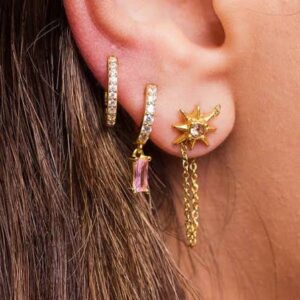
If you’ve already begun your journey into ear curation, you know that it’s more than just a collection of metal—it’s an evolving project. To move from a “collection” to a “styled stack,” you need to master the nuance of how your jewelry interacts with your unique ear shape.
1. The Geometry of Balance
To keep your ear from looking cluttered, think of your ear as a composition of Visual Weight.
Weight Distribution: If you have a heavy, dangling charm or a large cluster in your lobe, keep the upper cartilage (helix or flat) minimalist. A single, tiny diamond stud creates a “point of light” that draws the eye upward without competing with your main piece.
The Line of Sight: When someone looks at your ear, their eye will naturally travel from the lowest point (the lobe) to the highest (the helix). Place your most intricate or “hero” pieces along this natural path to create a cohesive narrative.
Creating “Anchors”: Use your larger piercings as anchors. Place your boldest, heaviest piece in a stable area (like the conch or the lower lobe) and let your smaller, accent pieces (like forward helixes or tragus studs) fill in the surrounding space.
2. Technical Tips for Long-Term Health
Even the most beautiful ear will suffer if the technical foundation is weak.
The “Threadless” Advantage: If you love to swap your jewelry out to match your outfit, prioritize threadless jewelry. It uses a simple tension pin system, meaning you can swap the decorative top (the front part) in seconds without needing a piercer’s help or a set of pliers.
The Metal Check: Are you still wearing “surgical steel”? That is often a catch-all term for an alloy that may contain nickel, which is the most common cause of skin reactions. If you feel itchiness or see redness, switch to implant-grade titanium (ASTM F-136) or 14k solid gold. Your ears will thank you instantly.
Managing Swelling: If you get a “flare-up” (sudden swelling), don’t just reach for saline—reach for a cold compress. A clean, chilled gel pack wrapped in a paper towel held against the ear (not on the piercing) can help reduce inflammation and bring the area down to size.
3. Styling “Tricks” to Elevate Your Look
Texture Mixing: One of the most “professional” ways to style your ear is to mix textures within the same metal color. Combine a smooth, high-polish hoop with a “hammered” or “beaded” ring. The contrast in how they catch the light makes the stack look much more expensive.
The “Charm” Upgrade: Don’t buy new piercings if you want a new look. Buy charms that attach to your existing hoops. A single hoop with a detachable charm can transform from a “daytime” staple to an “evening” statement in a few seconds.
The “Hidden” Placement: If you want a cool look that feels exclusive, look into a conch piercing. Because it sits in the “bowl” of the ear, it’s a beautiful place for a ring that hugs the curve of your ear, creating an incredibly elegant, circular frame.
4. When to “Edit” Your Ear
Sometimes, less is more. If your stack feels like it’s becoming “too much”:
The Seasonal Audit: Take a photo of your ear and step away from it for a few days. When you look back, which piece feels the most “out of place”? Sometimes, removing one single piece can make the entire ear look suddenly refined and intentional.
The Comfort Test: If you find yourself constantly fiddling with a specific piercing, it might be the wrong type of jewelry for that spot. For example, a hoop in a helix that is constantly being caught by your glasses or hair may never heal properly. Sometimes, the best technical “tip” is to accept that a different jewelry style (like a flat-back labret) would be more practical.