
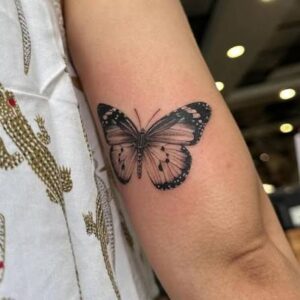
One of the most common points of friction between a client’s vision and an artist’s execution is the concept of scale.
You might walk into the studio with a beautiful, intricate design in mind, only for your artist to gently suggest making it 20% larger. It can feel like they aren’t listening, but in reality, they are looking at the long-term physics of your skin. Here is why choosing the right scale is the single most important decision you can make for your tattoo’s longevity.
1. The “Diffusion” Effect
Skin is not paper. It is a living, moving, elastic organ. Over time, the ink particles deposited in your dermis migrate ever so slightly. This is a natural biological process.
The Crowd Factor: If you cram a design with too many fine lines and tiny details into a small space, those lines have nowhere to go as they naturally soften over the years. Eventually, they will “blur” together, turning a crisp image into an indistinguishable shadow.
The “Bigger is Better” Rule: By scaling a design up, you give the ink “breathing room.” This ensures that even after a decade of natural skin changes, the negative space remains clear and the details stay distinct.
2. Anatomy and Flow: The “Body’s Map”
A tattoo should not just sit on your body; it should work with your body.
Respecting the Curves: A design that is too small might get “lost” on a large surface like your thigh or back. It looks like an island in an ocean. A larger piece, however, can follow the natural muscle flow, wrapping around the curve of a bicep or the contour of a shoulder, which turns the art into a cohesive part of your anatomy.
The “Distance Test”: Think about how people will see your tattoo. If you want your art to be recognizable from five feet away, it needs to have enough size and bold contrast to be readable. Tiny, cluttered tattoos tend to look like smudges from a distance; larger, well-scaled pieces command the space.
3. The Artist’s Perspective
When an artist pushes for a larger scale, they are usually trying to protect their work—and your investment.
The Apprenticeship Lesson: Every professional artist spends years learning how tattoos “age out.” They have seen thousands of pieces that didn’t hold up, and they know exactly why. When they tell you “this needs to be bigger,” they aren’t trying to upsell you; they are trying to ensure that you don’t have to spend money on a cover-up or an expensive laser removal in five years.
Collaborate, Don’t Compromise: If the artist suggests a size that you aren’t comfortable with, ask them to show you why. Ask them to draw the stencil at both sizes. Seeing the difference on your own skin is often the “aha!” moment that clarifies why scale matters.
4. The Balance of Your Collection
If you plan on getting more than one tattoo, consider how the scale of each piece interacts with the others.
The Visual Hierarchy: You want your tattoos to look like a curated collection, not a random collage. Mixing massive, high-detail pieces with tiny, delicate ones can create a disjointed look. Aiming for a consistent scale across an entire limb or section creates a sense of harmony that is visually striking.
A Final Thought on Vision
Don’t be afraid to think big. Sometimes we limit our designs because we are afraid of the commitment or the pain, but the final result of a well-scaled piece is a source of pride that lasts a lifetime.